Showing posts with label China. Show all posts

Monday, 9 May 2016

How My MBA Training Saved Me on a 6,500-Foot Cliff

A version of this post was originally published on the Duke Cross Continent MBA Student Blog from the Fuqua School of Business. 
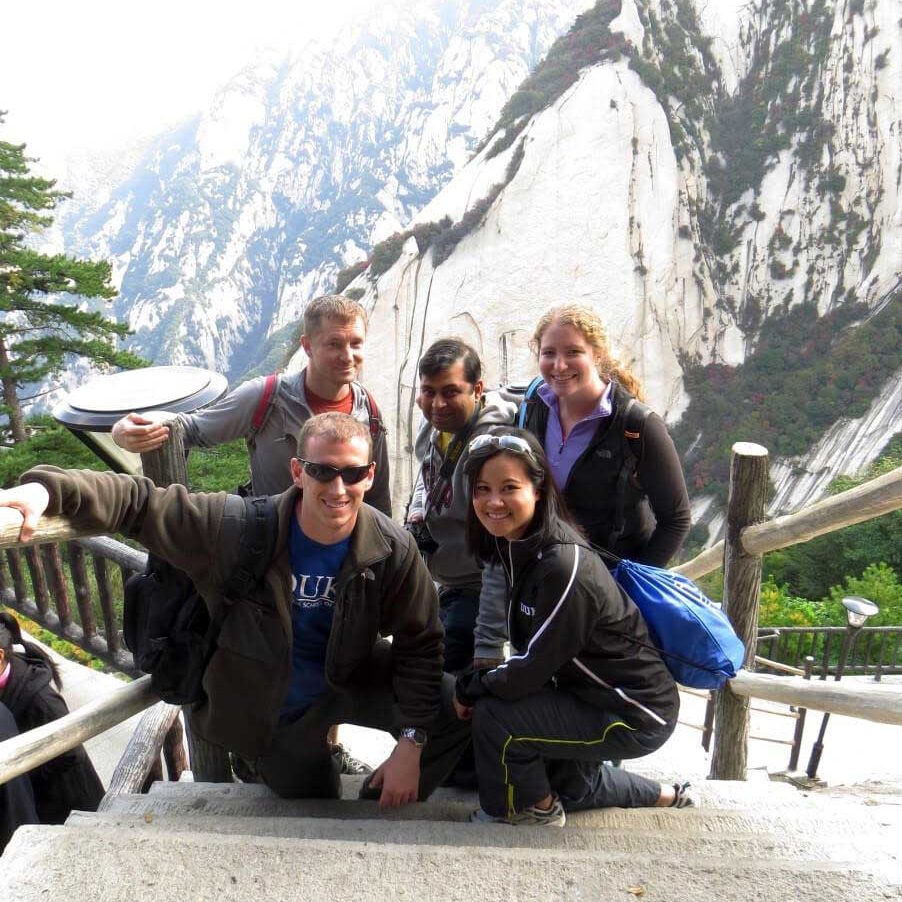
My MBA training came in handy on this mountaintop
My travel mates designated as “Team Xi’an”

MBA lessons can prove practical in unlikely places.
I’m hanging off the side of Mount Huashan in China, dubbed “one of the most dangerous and terrifying hikes in the world.” Attached to the mountain by a questionable 4-foot harness, I have to walk across a 1-foot wide wooden plank. Looking down more than a mile to the ground, I’m remembering that I’m deathly afraid of heights.
Of course, this was my idea to begin with.
This past summer, my 114 classmates and I began our MBA journey as a part of the Class of 2016 in the Fuqua School of Business Cross Continent MBA Program. Living and working in various parts of the world, we enrolled in the working professional program to allow ourselves to earn an MBA while keeping our full-time jobs. A core part of the program is to attend international class residencies and essentially travel the world studying, going on corporate visits, and immersing ourselves into various cultures.
Krystina - MBA Lessons plank walk
Hiking the “Plank Walk” at Mount Huashan…smiles cover up our fear of heights!

Our first international residency was to the powerhouse of China, whom the IMF deemed the world’s largest economy just a few months prior. A handful of us decided to arrive one week early to explore Xi’an before classes began. During my travel research, every web site stated that we couldn’t miss out on the infamous “Plank Walk” at Mount Huashan, a sacred Taoist mountain located in the Shaanxi Province.
The route is a complicated one. After about 2.5 hours of climbing up steep, vertical staircases (and we took one of the easier routes), the trail leads to the edge of a cliff. Before reaching the “Plank Walk,” there are steel rods about 2 inches long and holes in the rocks to climb down. The wooden plank is only a foot wide and to top it all off, there is only one exit. So as you attempt to walk or climb one way, there are other people attempting to walk or climb the other way around you. Carpe diem!
Flashing back to day 2 of our MBA orientation during the first residency at Duke, every student went through a team-building ropes course in small groups at the Triangle Training Center. The goal was to practice our teamwork and communication skills, capitalizing on each other’s strengths while identifying and improving upon our weaknesses. As I was hiking in China, I couldn’t have imagined that the same skill sets we worked on during the ropes course (and the entire class term) would come into play.
Krystina - MBA Lessons blue devilThe Blue Devil was a crucial member of the hiking team!

While climbing down the cliff, I couldn’t see directly below me, so I depended on my classmate to tell me exactly where to put my feet. Afterwards, I had to direct my other classmate where to go and predict the upcoming path for her. As people attempted to walk around us (and often we didn’t speak the same languages), split-second decisions had to be made to stay on the safest route. More importantly, given somehow that we all were afraid of heights (no one wanted to admit it until the few days leading up to the hike of course), we had to support each other so we could face our fears and encourage each other to push through the exhaustion from the long day.
When I first researched Duke, I knew of the emphasis placed around teamwork—which is not necessarily the case at other business schools. However “Team Fuqua” was simply a phrase I had heard before starting the Cross Continent program. As this experience has shown me and as every day passes, I’ve found that the spirit of “Team Fuqua” goes beyond a methodology. It’s a community of trust that has taught me to be a better leader, teammate, and communicator that can take on a boardroom or a 6,500-foot cliff.
Watch the video to see Krystina and her team’s treacherous route

Monday, 11 May 2015

Gi2C Guide: Must-Try Restaurants in Downtown Beijing

This post comes from my friends over at the Gi2C Group, an internship provider in China. Careful reading this post as you might get hungry enough to jump on a plane to do some great eating in Beijing!

Beijing is a superb place to live if you are a foodie. Not only is the authentic Chinese food in the Jing delicious and extremely diverse, but you also have a plethora of international delights that will whet your appetite. Don’t waste your time cooking at home in Beijing. Even if you ate out every day, it would take you several years to try all of Beijing’s fabulous restaurants. Save yourself time by avoiding the multiple trips way out to IKEA to stock up on kitchen supplies and instead focus on finding a good job to pay for your soon-to-be crazy high food budget. You’ll also want to invest in several pairs of pants with quality elastic waistbands.

Almost all of our Gi2C interns are new to China and Beijing, which is exactly why we wrote this guide.We want to help Beijing interns and everyone else enjoy the great China capital of Beijing to the fullest. Literally. You will get very full living here. If you live close to the Second and Third Ring roads on the east side of downtown Beijing, you will want to get out and experience the following five eateries for yourself:


Photo courtesy of Gi2C Guide


1. Makye Ame Tibetan Restaurant 玛  吉阿米
11A Xiushui Nanjie, Jianguomenwai Chaoyang District
朝阳区建国门外秀水南街甲 11号
Hours: 10am – Midnight

Makye Ame has excellent Tibetan food as well as dinner entertainment.  The restaurant is extremely hard to find but think of it as your own secret location and enjoy the hunt to discover this delicious treasure. Food is not cheap at Makye. Dinner for two may cost you around 500rmb (US$80) for four dishes depending on which dishes you choose and how much Tibetan butter tea you drink. If you are looking for an internship in Tibetan dancing (a competitive industry for internships), this is the place for you. Dust off your business cards and get ready to network. The Tibetan dancing and singing begins at 8pm.


Photo courtesy of Gi2C Guide

2. Bazha Tongga Tibetan Restaurant 巴扎童嘎藏餐吧
Southwest corner of Dongzhimenwai Dajie and Xindong Lu Chaoyang District
朝阳区东直门外大街新东路十字路口西南角
Hours: 10am – Midnight

As you walk up the stairs of this restaurant on the busy corner of Dongzhimenwai, you walk into a whole new world, magic carpets and all. Tibetan relics and adornments surround you as you take your place at a wood table. The menu boasts a great deal of dishes; however, when we were there, some were unavailable. The wait staff are extremely entertaining and are more than happy to break out in song if you ask them. They also provide good recommendations if you have no idea what to order.  Dishes are mid-priced which means dinner for two might run at most 300rmb ($50). 


Photo courtesy of Gi2C Guide


3. Middle 8th Yunnan Restaurant中八楼
Zhongba Lou, Sanlitun Zhongjie Chaoyang District
朝阳区三里屯中街中八楼饭馆
Hours: 11am – 11.30pm

You might not expect to find such a classy restaurant serving Yunnan style food hidden away in a tiny,dirty hutong, but that’s what we love about China: the surprises and new discoveries.  The food can get a little spicy so if you are sensitive, be sure to ask the wait staff to keep it mild for you. One item to absolutely order from the menu is their rice wine, which is served in a giant piece of bamboo. It has a relatively low alcohol content and tastes simply divine. If you’re in a rush, it is advisable to make reservations ahead of time as Middle 8 is often quite busy. However, they provide great snacks shipped all the way from Yunnan in the waiting area which makes having to wait not so bad. 


Photo courtesy of Gi2C Guide


4. Haidilao Hot Pot 海底捞火锅
2A Baijiazhuang Lu (next to No. 80 Middle School) Chaoyang District
朝阳区白家庄路甲 2  号 (八十中学西侧)
Hours: 24/7

One simply cannot leave China without having hotpot. Hot pot comes in all shapes and flavors in China but a foreigner favorite hotpot destination is Haidilao. The customer service is superb (which is extremely rare in China), there’s a variety of food to make any picky eater happy and you are able to play games, eat snacks, or even have a manicure while you wait to be seated. They also provide a play area for small children. What’s not to love? Be sure to make a reservation well in advance as this place is almost always packed. Eating hotpot is something to do with a big group of friends, but if there are only two of you expect the bill to be around 200-300rmb ($50). If this Chaoyang location isn’t convenient for you, they have multiple locations around Beijing. In advance of your first visit, you’re welcome.  


Photo courtesy of Gi2C Guide

5. Xiaodiao Litang 小吊梨汤
14 Baijiazhuang Dongli, Chaoyang District
朝阳区白家庄东里甲 14号
Hours: 11am-9:30pm

Xiao Diao Li Tang is off the radar of most foreigners. However, they have several locations around the city, and oh my, do they have yummy, home-style food. This particular location can be a little tricky to find as it’s down a small alleyway but once in the general area, simply show the locals the address and they will point you in the right direction. If you’re craving Chinese comfort food, look no further. Prices are also quite reasonable so don’t be shy about ordering too much. Two people ordering four dishes might end up with a bill slightly over 100rmb ($15). If you’re a Gi2C intern on a tight budget, this is the place for you.

Let us know what you think of our five favorite east Beijing restaurants in the heart of downtown! You can read more info about life in Beijing and other delicious restaurants at the Gi2C blog.

This Beijing restaurant guide is brought to you by Gi2C Group. Gi2C has been an internship provider in China since 2008 and has become a leader in the China internship industry. Gi2C’s goal is to help students and young professionals not only gain China work experience but also to help them understand China and Chinese business culture. Gi2C provides tailor-made opportunities for interns to work for a variety companies in multiple industries based in China. Gi2C also provides daily support for Gi2C interns as needed for the duration of their stay in China.

This has been a sponsored post with our partner HelpGoAbroad. Note that I would not post content that I would not agree with.