I joined the Peace Corps for many reasons, but the biggest one of all was to serve. Serve my country, serve others, serve the world. In the world of international development, it can be hard to know what works and if it makes a difference. From two years of primary research, I can say: The Village and Savings Loan Association works.
The Village Savings & Loan Association, created by CARE International, is a global microfinance model that provides access to capital and a means of savings for the most impoverished and illiterate members of our world. If you care to learn more logistics, see my previous post or watch the video below.
I've had the opportunity of creating and maintaining 14 of these groups with 375 members. Ninety percent of the participants are women and 80% are illiterate. Our average group ROI is 30% annually and the project is done in almost 60 countries with 6 millions participants worldwide. Like I said, it works.
Tuesday, 10 July 2012


Sunday, 1 July 2012
Small Donation to African Farmer Greatly Helps His Cabbage Farm
Before I left for Peace Corps, a friend's mom told me that she wanted to help in any way she could. She was hesitant to just donate funds directly to organizations because she never knew if the gift actually made it to the people she wanted to help or got lost to others along the way.
I often do not believe in first world countries just providing monetary aid to third world countries as this creates a sense of dependency. For example, just the fact that I'm a foreigner, people will assume that I am rich and will ask me for money because they've seen so much financing going towards the country. After two years; however, I found a very sweet man that was deserving of such a small gift without expectations.

Zachary and his new farm
After two years, I had made a very good (and honest) friend named Zachary. I won't go too much into detail about Zachary's story, but know that he was fired from his job for unjustified reasons and was the sole provider for a sick wife and three children. He worked to get his life back together by renting farm land and a simple donation allowed him to buy a starter pack of fertilizer for his farm. See below to see what $60 can do (and an embarrassing video of me losing my shoe):
Monday, 25 June 2012
Behind-the-Scenes: Making a Vampire Movie in Cameroon
When my buddy, Biya, asked me to act in his film, how could I say no? In my eyes, there would be no better way to wrap up my Peace Corps experience than to star as the heroine in a vampire movie! This was also not just any movie. This was a grand production of the "Who's Who?" of Ngaoundere's artistic outlets.
The movie premise? As I put on makeup in the bathroom of a nightclub, I see the vampires approach the dance floor. I run out to save the nightclub goers and stake the vampires. Unfortunately, I myself die in the process. It's a goodie!
Unfortunately, the timeline of the film is on "African time," so I really will never know when it gets finished. Until then, all I have are these behind-the-scenes photos and videos until the world premiere of "Easy Blood."

.jpg)
Wednesday, 20 June 2012
Peace Corps Project: The Grand Opening of the Mbideng Market!
After two years of serving in the US Peace Corps, it is only fitting that my capstone project came to a close (or rather opening!) today. For the past six months, community leaders, volunteers, and I worked to create an outdoor district market for the poverty-stricken neighborhood of Mbideng. Lying in the outskirts of the city of Ngaoundere, the 8,000 residents had to previously walk into town or pay for transportation to buy basic food and goods. Now the community has its own market providing such benefits as better nutrition and increased income
The past months included many tasks including building a coalition of leaders, holding multiple community meetings, negotiating with landlords and government officials, drafting contracts, performing word-of-mouth and radio publicity, and finding creative solutions amongst limited (i.e. zero) resources. Welcome to the Mbideng Market!

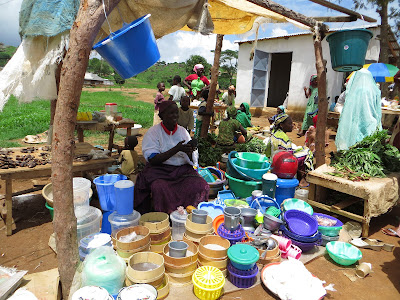

The past months included many tasks including building a coalition of leaders, holding multiple community meetings, negotiating with landlords and government officials, drafting contracts, performing word-of-mouth and radio publicity, and finding creative solutions amongst limited (i.e. zero) resources. Welcome to the Mbideng Market!

Traditional scarfs and prayer mats

The very first vendor!

Vegetable section
*By July 4, 2012, 136 vendors had come to sell their goods from all over the city. The mayor aided in publicity by securing announcements with public and private radio stations. Ninety percent of vendors surveyed stated that they have seen their daily incomes increase. One hundred percent of clients surveyed stated that they save time, money, or both by buying from the community market as opposed to going into town.
Monday, 4 June 2012
From Traveling Tourist to Living Local...Really Local: Life in the Peace Corps
This blog post was originally published for Do It While You're Young, a community and network for women ages 18-35 who previously or are currently traveling, studying, working, or volunteering abroad.
The best travel experiences occur when one breaks out of “tourist trap” attractions and into the local scene: where locals eat, how locals live, etc. It’s then when one can really experience another culture and therefore begin personal growth and mutual understanding.
What if, though, beyond traveling like a local, you actually became one? Not just going through the motions for a few days, but living abroad for an extended time? Now, to take it further, what if you forwent a traditional American salary for two years to live in a developing country all the while providing your talents to a greater cause?
Welcome to life in the Peace Corps!

What exactly is the Peace Corps?
The Peace Corps is an independent government agency that places volunteers in developing countries in various sectors across business, education, health, environment, and community development. Volunteers serve for 27 months (two years of service after three months of technical, cultural, and language training) living at a level next to those they are serving. Simply put, not only are you aiding in grassroots development, but it’s your job to foster cultural exchange too.
Where Volunteers Serve
Peace Corps Volunteers serve all over the world from Latin America to Eastern Europe to Southeast Asia. I live in Cameroon working as a Business Advisor for the Community Economic Development program. Contrary to popular belief, no, I don’t live in a small African village without electricity (though my best friend does!), but rather a second-story apartment in a city of 400,000 people, mostly Muslim and Christian.
Work Volunteers Do
In Cameroon, we have everything from Science teachers in schools to Community Health Volunteers in hospitals providing HIV/AIDS outreach. I’m a Business Volunteer, so I consult a microfinance institution and organize illiterate men and women into micro-credit cooperatives to provide a means of savings and lending for business-related activities. I also work with A2Empowerment to help girls who have dropped out of school return to school. Each Volunteer’s community is different, so it’s impossible to predict the work you’ll do, but you can create the experience you want.
Basic Essentials
The Cameroonian government provides private housing and Peace Corps provides a stipend that is more than enough to cover food, travel, communication, health, and miscellaneous expenses. I find it more than sufficient to cover all my needs; some Volunteers end up saving a couple thousand dollars through the experience while others dip into American money that they’ve saved – it’s all about money habits!
It may be Sub-Saharan Africa, but the world is a globalized one. Being in a large city, I can Skype my friends and family (well, if internet is working) and even the Volunteers who live “in the bush (i.e. WAY out there!)” have cell phones. We’re provided a bicycle, but I much prefer to ride motorbikes all over the city or to a local waterfall that’s 15km away (my friend in Panama received her own canoe!).
What I Love About Being a Local
I came to Cameroon with a bare understanding of French and now I find myself thinking and leading meetings in French! There is a high degree of illiteracy in my city, but since I’ve been here so long, I’ve been able to pick up the African language of Fulfulde. Do you know how much Cameroonians love it when you speak their native tongue? A lot.
It’s the moments that I could have never predicted that I love the most. For one of my birthdays, I ended up riding on the back of a motorbike for six hours in the rain. We stayed at a notable’s house and climbed caves the next day that were 30 meters below ground. The rest of the afternoon was spent war dancing with the Nyem Nyem people. Forty-eight hours earlier, I had no clue this would even happen. Knowing fair prices at the market, playing on the local soccer team, developing close relationships – this is life!
What I Hate About a Being a Local
I may be sporting clothes from African fabric, but Americans stick out worst than pimples on prom night. Some days I enjoy the celebrity status, and other days, it’s like a self-conscious fishbowl! No matter what I do is weird, so I just tell everyone else how weird they are too. I’ve also definitely picked up my fair share of foreign diseases, but hey, now I have good stories right?
Though it’s a tough and humbling experience, I’ve loved seeing Cameroon from the most first-hand perspective possible as I was able to combine my passions of public service, travel, and business. It’s no wonder why Peace Corps’s current tagline is “Think local. Act Global.”
Sunday, 13 May 2012
Ouch! That Monkey Just Bit Me! Backpacking West Africa..
This blog post was originally published for Do It While You're Young, a community and network for women ages 18-35 who previously or are currently traveling, studying, working, or volunteering abroad.
I’m a believer that your age should never be greater than the number of countries you’ve visited.
I’ve lived in Europe, volunteered in Asia, and done quick stints in Australia and across North America. Couchsurfing, solo traveling, Contiki tours, eco-service trips, Peace Corps, you name it! Though a passion for travel still ignites a fire in my petite belly, there aren’t many experiences that can really make me say, “This is crazy!” Until a few months ago; however, two girlfriends and I decided to backpack West Africa for 24 days…
Mali – The Gem of Africa
Staying at the Sleeping Camel in Bamako allowed us to acquire the “need-to-know” information about the city. The Artisan market had an incredible selection of wood crafts and jewelry forcing the three of us to stock up (why I bought a drum the first day to carry around I still don’t know!). The music scene and night life on Route de Bla Bla – yes, that’s really its name – allowed us to kick off our trip in full force.
There may be nothing more awe-inspiring than UNESCO’s World Heritage town of Djenne. It’s here where we were mesmerized by the Grand Mosque- the largest mosque in the world made completely from mud! Not only are the homes constructed from mud as well, but they are multi-storied creating an ancient town of varying building heights.
Soon it was time for our three day hike across Dogon Country. At arrival our guide stated “We are going to hike for 15 kilometers this afternoon. This will take five hours if you walk well.” Keep in mind that I’m a former New Yorker that used to take the subway from 34th to 42nd Street! Nonetheless, sleeping on roofs under the stars and seeing pure, untouched Africa was incredibly surreal. During our (ridiculously long) hike, we came across Tiogou, a village built on rock formations supporting waterfalls and Youga Dogourou, a village where inhabitants live inside a mountain’s crevices!
Burkina Faso – No Man’s Land
After an ATM fiasco (let’s just say $400US was taken out of my checking account though I never physically received the money!), we jumped on an 8-hour bus to Bobo-Dioulasso (where you ask?!). Yes, Burkina is very much OFF the beaten path, part of its lure! The country is one of the poorest in the world, yet since it is a transport country, the roads are upkept.
We received a local tip to shop at Gafreh Boutique, a fair-trade store that showcases products created from recycled plastic bags. At Banfora, we touched the Karfiguela Waterfalls and the Sand Domes of Fabedougou before heading off to Burkina’s capital, Ouagadougou (say this five times fast!).
Togo – Not the Sandwich, But a Lovely Country
When we reached Togo, we searched the village of Goundoga for a secret “castle in a cliff” (okay, maybe not too secret as we read about it in a Lonely Planet guide, but it’s definitely not a touristy place)! While traveling there, I realized we had no clue where we would spend the night. “Would you like to stay at the chief’s house?” my chauffeur inquired. Yes!
It turns out our “castle in the cliff” was actually a mini-fortress with a steel ladder built into the side of Mt. Semoo during the 19th century. The Chokossi had established an empire; however, the Moba resented this and built the fortress to hide from soldiers and tax collectors. Just like the IRS!

After a 12-hour ride (yes, 12 hours!), we welcomed the cool-climate of Kpalime, a tropical paradise amongst hilly forests, artisan markets, and cocoa and coffee farms. The best activity to do here: butterfly hunting!
Lome was my favorite city of the trip with its gorgeous beaches (check out Aneho too!), great shopping, delicious restaurants (Vietnamese pho anyone?) and voodoo! An affordable place to stay is Le Galion, which is walking distance to the beach. I would have recommended Chez Alice, 12km away in Aveposo, but the hostel’s monkey bit me!

Benin – Beaches and Stilts
The trip ended with a quick stop to Grand Popo – another beach resort (we needed it!) and Ganvie, a stilt village only reachable by canoe! At Ganvie, 30,000 Tofinu people live in stilt houses that sit two meters above water. Back in the 17th century, the Tofinu fled here to escape slavery as their attempted captors, the Dahomey, were afraid of water and disallowed to enter it due to religion.
Be warned: backpacking West Africa is not for the novice tourist or for those lacking patience! Bush taxis (i.e. squeezing 8 people into a taxi!), non-existent time-tables, a beating African sun, and constant negotiation are just the realities of a trip like this. However, for those searching for adventure, you will find nothing less!
Tuesday, 1 May 2012
Advice about Life to Future Peace Corps Volunteers
A few months ago, my Associate Peace Corps Director asked me to write a vignette about life as a Peace Corps Volunteer and to include any advice. The Volunteer Assignment Description will be provided to future Community Economic Development (formerly Small Enterprise Development) Volunteers coming to Cameroon...including my replacement. Here we go:
Small Enterprise Development Volunteer Assignment Description Vignette
October 2011
“Jam na?” In the local African language of Fulfulde, this translates into “Do you have peace?” Before every meeting, I must traverse the room repeating this to each attendee. I could have never predicted exactly what my projects would entail of as a Small Enterprise Development Volunteer. Some days, I facilitate the meetings of savings and lending cooperatives for illiterate women; other days, I organize artisan classes to teach income-generating activities. And of course, as cultural exchange is a part of the job description, I spend other moments dancing at Muslim weddings and playing “football” with the kids. As a Peace Corps Volunteer of this generation, you will find yourself in a transitioning world. I’ve helped women who weren’t allowed to attend school as children to create e-mail addresses. Sometimes I Skype with family and friends and sometimes I write letters by candlelight. Realize that although every Volunteer’s post is different, your own attitude and flexibility will be the true determinants of your experience. And do not worry, speaking French will come with practice and time for everybody. Life here is full of uncertainty and there will be instances of frustration as in every job, but let yourself laugh, remember that development and impact require patience, and treasure the small, everyday moments of this once-in-a-lifetime adventure.
Krystina Nguyen, SED Volunteer
Ngaoundéré, Adamawa Region
Sunday, 8 April 2012
International African Festival of the Nyem Nyem People
The International Festival of the Nyem Nyem people annually takes place in the Adamawa region of Cameroon. Villagers and visitors climb into caves in the village of Galim while the Nyem Nyem people celebrate with war dancing. Though it’s deemed international and occurs yearly, it’s actually quite difficult to find concrete information about the festival. Being Cameroon, logistics take place at the very last minute and most publicity is done by word-of-mouth.
Thus, it was only through my Fulfulde (local language of Cameroon’s Grand North) instructor that I found out about the festival. He originally told me the dates were April 16-April 18th, but the members of the Red Cross told me April 7-9th. I did a final check with the Delegate of the Ministry of Tourism who stated April 6-8th. Like I said, concrete information is hard to come by!
I was in Yaounde for my Peace Corps Close-of-Service conference until April 5th, so when I arrived to Ngaoundere by the night train, I wasn’t sure what would really happen. And if someone had told me what would occur, I probably wouldn’t have believed them anyways.
At 11AM, Esther, a teacher and community volunteer, and I headed off to Narral bus agency. The only bus to Galim left earlier in the morning, but we could take a car to Tignere, which was only 55km away. The issue was that there was only a 1:30PM bus which was already full! We had to get there by nightfall as the war dancing would occur in the early morning.
Esther went to Alliance bus agency and called her friend at National bus agency to see if there were other cars – both fails. I called the Red Cross, but they had already left. The Delegate of Culture had already left as well. Renting a car would be too expensive on my Peace Corps salary. How would we get to this festival that was 145km away?
And that’s when a crazy idea hit me in the face. Why don’t we motorbike there? In the Ngaoundere area, you only motorbike 5km or so, no more. Otherwise, you always take a car. With no options left, I called a friendly motorbike-driving friend of mine, Obro. He and Esther said they would be in for a three-day adventure. Let’s go!

About three hours into the journey
So we were mistaken and it wasn’t 145km, but rather a 200km drive with the three of us piled on Obro’s motorbike. It was uncomfortable, but manageable…until I saw the rain clouds. “Ca va aller. Il n’y a pas un problem! (It’s good. There’s no problem!),” Obro said. It started to sprinkle and I held my breath. It stopped. Phew. It started to sprinkle again. Then no more. On the third sprinkle, it was a downpour!
Unfortunately, we were in the middle-of-nowhere with neither nothing nor no one in sight, so the only option we had was to keep on driving! Of course, the rains stopped once we reached a small village where Obro stopped to pray and we ate lunch. As we arrived to Tignere, we decided to continue on to Galim. Obro made a call as he said this would be the last place we’d have cell phone service. “Obro, do your relatives know we’re staying with them when we get to Galim?” I asked. He said no and as I proceeded to question him, it turned out that he’d never met these long-lost relatives. “Ca va aller. Il n’ y a pas un problem!” he says.

Still not there, but rather the middle-of-nowhere


He was happy to see an American
So there I was squeezed between a taximan and a teacher headed off to the tiny Cameroonian village of Galim, no clue where I will spend the night nor would I have cell phone service. Did I mention five hours had already passed by on this muddy motorbike? Sometimes I hate my crazy ideas.
Another hour passed and voila! We reached Galim safely and there was already dancing at the Lamido’s (traditional chief’s) palace. As I sorely jumped off the moto, I realized Obro didn’t have a suitcase. “Ca va aller. Il n’y a pas un problem!” he says.
The Lamido’s son, Aboubakar, saw little foreigner me and offered us a place for the night. Obro went off to find his long-lost relatives with whom he’d stay and Aboubakar led us inside the palace to a lavish meal of plantains, pasta, fruits, vegetables, and meat. Back at his house, I “bucket bathed” outside underneath the stars as I questioned whether this was actually reality.

The veranda to the house where we stayed for the weekend

Our host, Aboubakar, the son of the traditional chief
In the morning, Aboubakar had a motorman take us back to the Lamido Palace where we ate breakfast before running into the Red Cross volunteers and a few other people I knew from Ngaoundere. After breakfast and the arrival of the traditional chiefs of the nearby villages, we headed off to climb the caves on Mont Djim! Apparently, there’s a magic water spring that you can drink from that will cure all ailments, but I was more interested in the war dancing (and I didn’t believe it would cure my ailments but rather give me some sort of disease).


Let the music and horse fantasia begin!
On Mont Djim, fortune tellers predicted the future while it was one massive tailgate with food and yes, Cameroonian beer! We also hiked to the Execution Zone, where enemies would be thrown off the mountain after becoming beheaded. Why I decided to climb caves and hike in a dress and flip flops, please don’t ask!

Cave climbing in Mont Djim

Waiting for the war dancing

Hiking to the Execution Zone on Mont Djim
Back at the Lamido Palace, no one was really sure what was occurring until finally, the Nyem Nyem war dancers appeared! I’ve spent the past two years in Africa, but this performance was the liveliest dance I’ve seen with men, women, and children actively participating. I spent the next hour in awe as the men threw the children on their shoulders while dancing to the beat of the drums.


The Nyem Nyem war dancers - glorious!
The next morning, we jumped back on Obro’s motorbike to head home to Ngaoundere. Everyone knew us that weekend as we were the crazy ones that rode a motorbike the 200km to the festival (and well, I was the only American/foreigner in the sea of Cameroonians!). As we drove, Obro took a detour to Doualua, another small village. It turns out that his brother’s wife left him after he took on a second wife (polygamy is legal in Cameroon). Thus, Obro was on a mission to talk to her to get her to come back home to his brother after twelve years of marriage. As he tried to clear up the love triangle mess, I took a nap after finishing up my read “P.S. I Love You.” I guess it all worked out as she promised to come back if her husband would be nice to her.
I believed it was due to weight, but a part of the motorbike soon fell off. “Ca va aller! Il n’y a pas un problem!” Obro stated as he tied the piece back with some rubber. Note: Always travel with duct tape! A couple hours later, we survived another downpour which later turned out to be a blessing as the motor overheated and the mud water was able to cool it down.
We had left that morning at 8AM and I finally arrived to my house at 6PM. Over 13 hours on a motorbike. In the pouring rain. To climb caves 30 meters below the Earth. For war dancing with the Nyem Nyem people. In the tiny West African village of Galim. Did I mention that this was also my birthday weekend? Ca va aller!
Thursday, 5 April 2012
Peace Corps Close-of-Service Conference
Twenty-seven months. That's how long the US government asks you to serve when you sign up for the Peace Corps.
When I first told people that I was joining the Peace Corps, some assumed it was only a one-year stint and were excited for me. When I told them it was two years, their jaws dropped. "That's a long time!" they'd say. I know.
The average application process takes twelve months including legal and medical checks. Have unpaid parking tickets? You better pay them off! Credit card debt? Hmm, can you clear that up before you leave? I was one of the unlucky ones who had to remove a wisdom tooth. "It's just plaque and the dentist says that it's negligible," I told the Peace Corps Medical Office. They held my medical clearance until I took care of it.
From the time I submitted the application to the time I boarded the plane for Cameroon, two years had passed due to the process and due to life choices. Now, it's almost two years later and my Peace Corps service is done in just a few months.
My stagemates (Volunteers that started the same time as me) and I traveled to Yaounde, Cameroon this past week to Peace Corps headquarters. We started our journey together here and were reunited for our Close-of-Service conference. In the three-day conference, we discussed resumes, our service projects, and readjustment back to the US (some say that acclimating back to American life is the hardest part!).
I received my official French level of Advanced High from the American Council on the Teaching of Foreign Languages. My official Close-of-Service date a.k.a. when I board that plane back to the US is July 20, 2012.
Twenty-seven months. It goes by quickly.


 Group picture try #2

When I first told people that I was joining the Peace Corps, some assumed it was only a one-year stint and were excited for me. When I told them it was two years, their jaws dropped. "That's a long time!" they'd say. I know.
The average application process takes twelve months including legal and medical checks. Have unpaid parking tickets? You better pay them off! Credit card debt? Hmm, can you clear that up before you leave? I was one of the unlucky ones who had to remove a wisdom tooth. "It's just plaque and the dentist says that it's negligible," I told the Peace Corps Medical Office. They held my medical clearance until I took care of it.
From the time I submitted the application to the time I boarded the plane for Cameroon, two years had passed due to the process and due to life choices. Now, it's almost two years later and my Peace Corps service is done in just a few months.
My stagemates (Volunteers that started the same time as me) and I traveled to Yaounde, Cameroon this past week to Peace Corps headquarters. We started our journey together here and were reunited for our Close-of-Service conference. In the three-day conference, we discussed resumes, our service projects, and readjustment back to the US (some say that acclimating back to American life is the hardest part!).
I received my official French level of Advanced High from the American Council on the Teaching of Foreign Languages. My official Close-of-Service date a.k.a. when I board that plane back to the US is July 20, 2012.
Twenty-seven months. It goes by quickly.

Fellow Greeter PCV, Benjamin Ace and I celebrating our last dinner

I love Ethan's traditional outfit!

Group picture try #1
 Group picture try #2
Peace Corps staff, Education Volunteers, and Community Economic Development Volunteers 2010-2012
Subscribe to:
Posts (Atom)